
VIP member
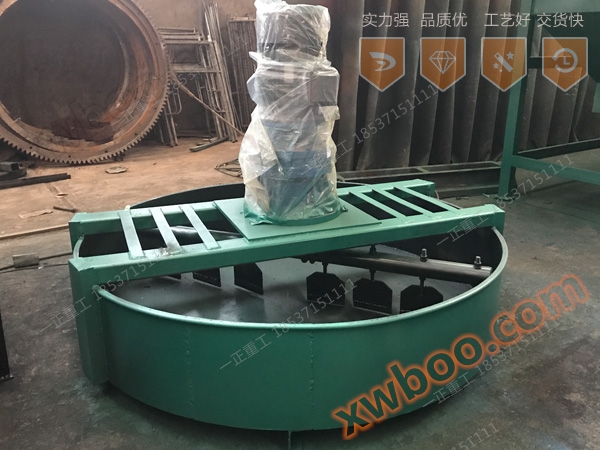
Vertical disc feeder
Service commitment: Yizheng Heavy Industry fully supports the development of customers' businesses with the "135" action (one phone call, three links,
Product details
1. Product Overview
Vertical disc feeder, also known as disc feeder, is mainly used to evenly supply raw materials to two or more equipment. Polypropylene lining or stainless steel plate can be added to the tray as needed, so that some highly corrosive and viscous materials are not easily stained, thereby extending the service life of the machine. The whole machine adopts a cycloidal pinwheel reducer, which has the characteristics of compact structure, uniform feeding, and beautiful appearance. There are two or more discharge ports under the disc body, making unloading very convenient.

2. Structure and principle
The vertical feeder consists of a disc body, a feeding arm, a frame, a reducer, an electric motor, and other mechanisms. Its working mode is to drive the reducer through the electric motor, and then drive the entire feeding arm to rotate at a constant speed, so that the staggered feeding blades evenly feed the materials. As the feeding arm rotates, the material flows out evenly. The discharge port can be controlled in size as needed to control the flow rate and ensure the normal production of the next process.

2、 Main technical parameters
model | diameter(mm) | Wall height(mm) | speed(r/min) | power(kw) |
Overall dimensions (mm) | weight(kg) |
WL1600 | 1600 | 250 | 12 | 5.5 | 1612×1612×968 | 1100 |
WL1800 | 1800 | 300 | 10.5 | 7.5 | 1900×1812×968 | 1200 |
WL2200 | 2200 | 350 | 10.5 | 11 | 2300×2216×1103 | 1568 |
WL2500 | 2500 | 400 | 9 | 11 | 2600×2516×1253 | 1950 |
3、 Installation, debugging, and maintenance
1. Installation: The machine is generally placed above the feeding port of the required equipment. A rack can be made according to the situation and placed on top of the rack, then fixed. The feeding port should be aligned with the feeding port of the required equipment for the material to flow out on its own. A plug valve can be installed on the feeding port pipe to control the feeding flow rate.
2. Debugging: After the installation of the feeder is completed, it is necessary to first check whether the various components of the feeder are fastened, and then add lubricating oil for no-load testing to confirm that the rotation direction of the mixing arm is correct. During the testing process, it must not rub or touch, there must be no abnormal noise, and no vibration.

3. Maintenance and upkeep:
a. Before using the reducer, lubricating oil must be added. The lubricating oil is generally HJ40-50 mechanical oil, or HL20-30 gear oil can be used. The oil level height of the lubricating oil should be within the range indicated by the circular oil mark on the machine base. After the first refueling operation for 100 hours, the oil should be replaced with new oil, and then replaced every four months. When changing the oil, it should be cleaned thoroughly.
b. Lubricate the bearings once every shift with a type of 3 calcium based grease lubricating oil, with a filling amount of 1/3~1/2, and regularly replace with new lubricating oil. The bearings should be cleaned during replacement.
c. Lubricating oil should be regularly dripped at the wrench of the discharge door to reduce labor.
4. Fragile parts:
a. Feeding leaf
4、 Instructions for use
1. When starting up, it should be done under no load, and it is strictly prohibited to start with materials. It is strictly prohibited to put too much material into the feeding process. The material should be limited to be submerged below 100mm of the feeding blade, otherwise the resistance will be too high and it is easy to damage the reducer and motor.
2. It is strictly prohibited to carry hard objects such as stones and iron blocks in the materials.
Before starting up, check if all bolts are loose.
4. After starting the motor, check if the rotation direction is opposite. If there is a reaction, stop and adjust immediately.
5. After use, discharge the remaining materials before parking to ensure smooth start-up for the next use.
5、 Common faults and troubleshooting methods
Fault phenomenon | 故障原因 | exclusion method |
1.The motor cannot operate normally | 1.Voltage too high or too low | 1.Wait for the voltage to stabilize before starting |
2.Motor phase loss operation | 2.Connect the missing phase and operate in three-phase mode | |
3.Motor winding short circuit | 3.Repair or replace the motor | |
2.The gearbox has abnormal noise | 1.Lack of lubricating oil | 1.Add lubricating oil |
2.Component damage | 2.Repair or replace the gearbox |
Online inquiry
-
Contacts
-
Company
-
Telephone
-
Email
-
WeChat
-
Verification Code
-
Message Content
-